
Why is Annealing Important? And What is AP? What is BA?
Annealing is a heat treatment process used to remove residual stresses and work hardening from metal materials. It makes the crystal structure of the metal material uniform and soft, which can improve the workability and toughness of the metal.
When metal is heated in the presence of atmospheric gases, the metal surface reacts with oxygen to form an oxide film. Pickling involves immersing stainless steel in an acid solution to remove the oxide film and surface impurities.
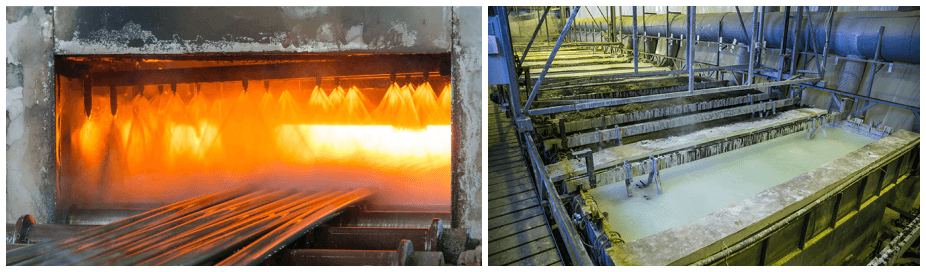
AP (Annealed and Pickled) tubes are stainless steel tubes that have undergone annealing and pickling treatment.
BA (Bright Annealed) tubes are stainless steel tubes that have been bright annealed during the annealing process.
Bright annealing is carried out in a protective atmosphere to keep the stainless steel surface bright and free from oxide scale after annealing.
What are the Processes for AP and BA?
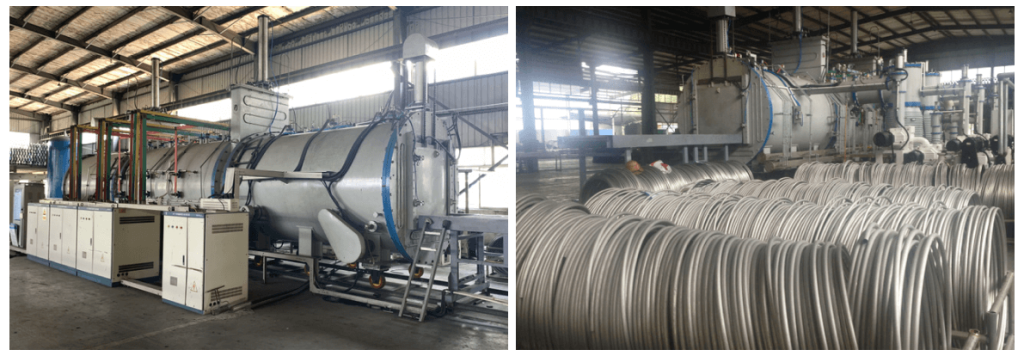
Bright Annealing (BA) Process:
- Cold Rolling: The stainless steel tube is cold rolled to achieve the desired size and shape.
- Protective Atmosphere: Annealing is conducted in a protective atmosphere (such as hydrogen or nitrogen) to prevent surface oxidation.
- Temperature Control: The annealing temperature is typically between 1040°C and 1120°C, depending on the type of stainless steel.
- Cooling Speed: Rapid cooling after annealing is required to maintain the surface brightness.
Annealed and Pickled (AP) Process:
- Hot or Cold Rolling: The stainless steel tube is hot or cold rolled to achieve the desired size and shape.
- Environment: Annealing is done in regular air without a special protective atmosphere.
- Temperature Control: The annealing temperature is similar to bright annealing, usually between 1040°C and 1120°C.
- Slow Cooling: The tube is slowly cooled after annealing.
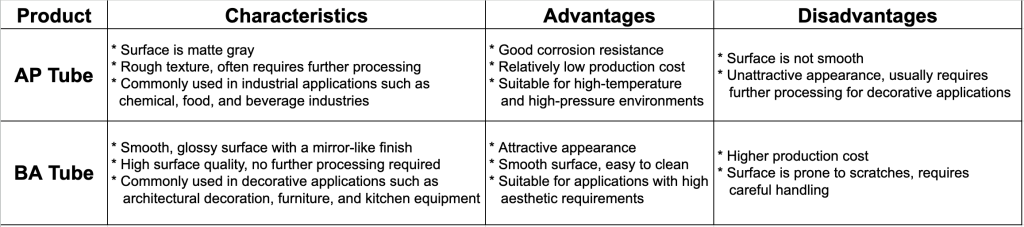
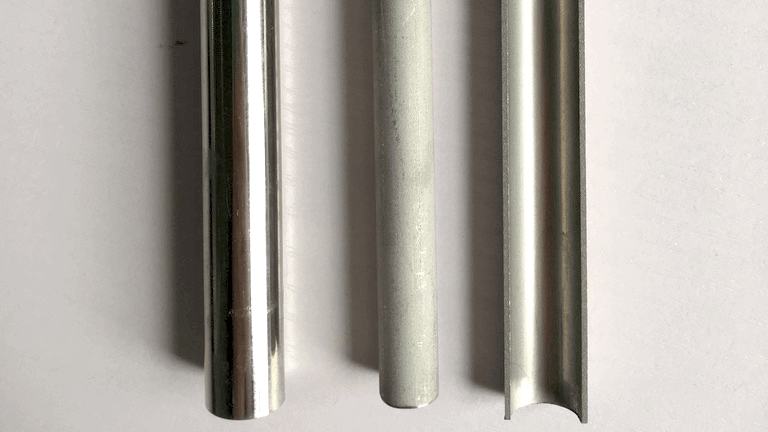
Comparison of AP and BA Tube:
Purchasing Recommendations
- Both AP and BA tubes are widely used in industrial applications, such as the chemical, food, and beverage industries, as well as in architectural decoration, furniture, and kitchen equipment.
- If both are seamless stainless steel tubes, the corrosion resistance and mechanical properties of AP and BA tubes are not significantly different because they use the same materials and basic processing techniques. Their corrosion resistance mainly depends on the alloy composition (such as 304, 316, etc.) and processing methods.
- The choice of surface treatment mainly depends on specific application requirements, such as appearance, inner bore cleanliness, and aesthetic needs. For high aesthetic requirements, choose BA tubes.
Diameter Consideration
For tubes with an outer diameter smaller than 1 inch (25.4mm), it is difficult to remove internal oxidation and surface impurities through traditional pickling. To ensure the cleanliness of the inner surface, we recommend using BA tubes.
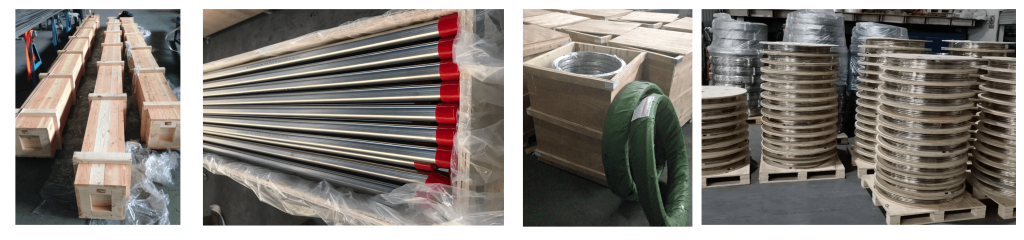
The packing for stainless steel BA tube
★★★ Review of previously selected articles:
- What is Bright Annealing of Stainless Steel Tubes?
- What is the Difference Between Annealed and Bright Annealed Stainless Steel Tubes?
- AP, BA, and EP Stainless Steel Tubes: Key Differences and Application Scenarios
- What is the difference between a stainless steel pipe and a stainless steel tube?
- Common Applications of Stainless Steel Tubes
- Is Stainless Steel Tubing Good for Heat Exchangers?
- Exploring Stainless Steel Tubing: Making the Right Choice for Your Fluid System
- What is Stainless Steel Coil Tubing and Why It Matters in Modern Industry
- Choosing the Right Stuff: Corrosion-Resistant Materials
Ask us a question
By fill the right form, you can send any questions about us and our products.
Get more information about us

Company Links
Contact Information
Ph: +86-21-62666697
Fax: +86-21-62999145
Mobi: +86 133 3793 7369
Email: link@jwgroup.cc
Add: No 2299, Xiangjiang Road, Shanghai, China